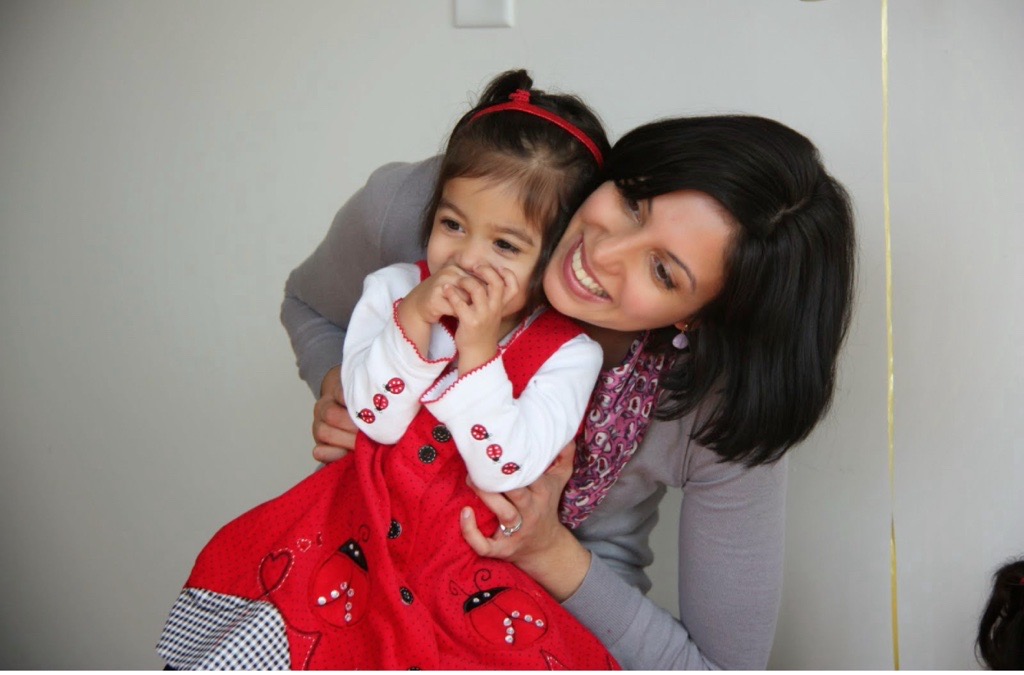
After her second birthday, my daughter began displaying mild symptoms of what I feared was a seizure disorder. As a genetic counselor, I was acutely aware of what another parent may have deemed trivial. I caught an episode on video and a few days later found myself in the waiting room of the best pediatric neurologist in Manhattan. The children in this room were a stark reminder of the news I could potentially face. I stared at the fish tank fighting back tears until the nurse called my daughter’s name.
The doctor reassured me everything was “probably fine.” The only way to confirm was to admit her to the hospital and monitor brain activity for 24-48 hours. We checked in, and my daughter got to choose the color of the EEG wires. She chose “rainbow,” and as they glued the multiple nodes to her scalp, I distracted her with games.
My daughter shared a hospital room with a nine-year-old girl being similarly monitored. This girl could not speak, and it was clear that my two-year-old was more advanced in milestones. In conversation, her mom informed me that her daughter had an undiagnosed rare genetic disease.
I listened as she related the story of her child’s history, which included multiple visits to physicians, routine EEG monitoring, occupational therapy, daily medications, and special schooling. As I waited to learn more about my own daughter’s situation, I briefly shared this mother’s deep sense of uncertainty.
It made me think of an article I read years ago about DNA testing, where I was similarly struck by the shared parental agony of waiting. In it, Dr. Richard A. Gibbs captures the extent to which parents search for answers: “[Driving] across the whole country looking for that one neurologist who can help, or scrubbing the whole house with Lysol because they think it might be an allergy.”
In the case of one of the families in the article, the wait finally led to a diagnosis and subsequent plans for lifelong dependent care. The article never mentioned DNA testing for rare disease in the pre-pregnancy stage, when family planning options are more abundant. For many prospective parents, the sense of urgency to pursue such tests at an otherwise exciting time is lacking. Planning for a child with a severe disability is unpleasant to ponder.
The fact is, the risk of conceiving a child with a recessive genetic disorder is approximately one to two percent for any couple in the general population.1 Hence, “rare.” But while the name emphasizes that these diseases are infrequent, the reality is that about 6,000 rare diseases collectively affect an estimated 300 million people worldwide.2 And let’s be honest, statistical rarity is irrelevant if your child is affected.
For those who would act on “high risk” results to pursue alternate routes of family planning—such as IVF with pre-implantation diagnosis, prenatal testing, gamete donation or adoption—it is worth noting that DNA testing can be performed long before your baby is born—or even conceived. Where parents would rather use the information to better prepare for a child with special needs, advanced knowledge of potential complications or treatment options is critical.
In the end, my daughter was in fact “just fine.” I still wonder about her roommate and whether she ever stopped waiting for a diagnosis. Uncertainty in parenthood is a given. But where there is a test that can minimize some of that uncertainty, waiting is somehow far less appealing.
References:
- Ropers HH. On the future of genetic risk assessment. J Community Genet. 2012;3(3):229-236. doi:10.1007/s12687-012-0092-2
- Nguengang Wakap S., Lambert D.M., Olry A., Rodwell C., Gueydan C., Lanneau V., Murphy D., Le Cam Y., Rath A. Estimating cumulative point prevalence of rare diseases: analysis of the Orphanet database. Eur. J. Hum. Genet. 2020;28:165–173. doi: 10.1038/s41431-019-0508-0.

Learn about the screening process and how to talk to your doctor.
How to get screened